
Scarcity is a luxury company’s most valuable resource. It does not show up in a company’s financials. Yet scarcity can be measured, and must be managed.
Hermès, like many luxury companies, appears to have overdrawn from its “Scarcity Bank” during the COVID-induced boom by monetising strong demand from speculators. Its share price has fallen by more than half since February 2025. The opaque (and potentially annoying) process it uses to manage access to its “scarce” flagship products is proving increasingly exposed to technology platforms and speculative traders who prioritise liquidity.
Faced with pressure on resale prices for its flagship products, traditional attempts to limit supply may not be sufficient. Restoring customer perceptions of scarcity may require disruptive changes to its business model, such as direct intervention in the secondary resale market. The need to implement such changes could be costly to investors in the near term. However, greater control over resale channels would improve the quality of the business in the long run.
This article describes the fundamentals of scarcity, the damage done during the COVID boom to Hermès’ Scarcity Bank and what it would take to restore it. Let’s dive in.
How (I think) Rich People Think
A Birkin 25 Togo may cost you US$13,500. It is hand stitched by one of Hermès’ highly trained artisans over 15 hours.
“If it’s not Hermès quality, then we don’t produce. And that is why it is important that we take the time to train people. We take the time to make a new model, and we also take the time to find the right raw material… I often complain that industrialisation of animal husbandry has led to a reduction in quality. That’s why we make a big investment in tannery.” Axel Dumas, Hermès International Executive Chairman, 2Q26 earnings conference call
Ah, the romance, the craftsmanship, the art de vivre of a ~200-year old luxury brand! However, Dumas’ obsession on quality and eschewing industrial mass-production speak to the key of any successful luxury brand – scarcity.
Imagine if you were rich (sigh). The first few dollars you earn would matter enormously. After all, you’d need it to buy food, pay for housing, etc. However, once all your necessities are met, those next dollars don’t mean as much. You now have a discretionary budget, which you are more willing to spend. The best way to understand this is by working through an example.
Chart 1: Discretionary budgets scale much faster with higher incomes
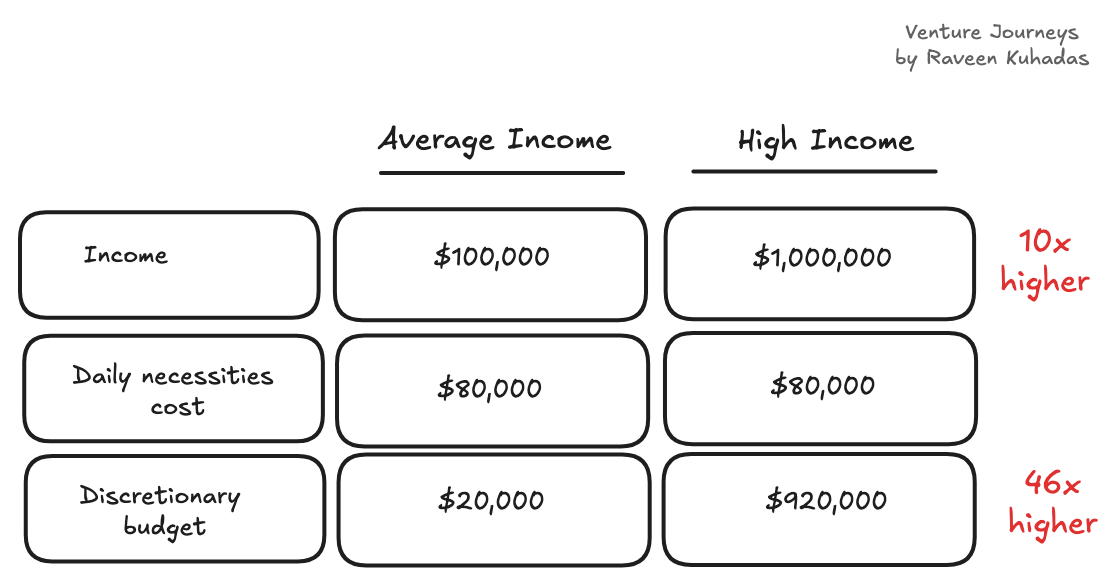
As shown in the chart above, disposable budgets scale much faster with high income. In this example, a person with a 10x higher income can have a discretionary budget that is 46x higher. The same $13,500 is 67.5% of an average income person’s discretionary budget but only 1.5% for a high income person. When you’re rich, you tend to be less price sensitive.
But this creates a (fabulous) problem for you. If the price is no barrier to you, it is no barrier to your rich friends either, so paying it no longer sets you apart. What matters is owning something that even people with money can’t simply walk in and buy. Something scarce.
The “Scarcity Bank”
Luxury companies face a dilemma. They are able to charge their rich customers a higher price only if their product is scarce. But a scarce product means that the company cannot sell too many of them, limiting growth.
To solve this, luxury companies must treat scarcity like a bank account – drawing from it prudently will allow the interest income to replenish the principal over time. However, drawing too much would cause the principal amount to shrink to nothing.
Similarly, luxury companies make a deposit into the bank by restricting the supply of their scarce flagship “quota” products and setting retail prices well below what the market would pay. To withdraw the “interest” without depleting the principal, they require customers to build up a purchase history with non-scarce “pre-spend” goods before they are allowed to purchase the scarce flagship item.
For example, Rolex customers are widely reported to need to purchase several less-coveted models with an authorised dealer before being allowed to buy its iconic Daytona or Submariner. Ferrari customers are expected to purchase several standard Ferraris before being invited to buy an Icona series (SP1, SP2, and SP3) model. Hermès customers reportedly need a purchase history of “pre-spend” items (footwear, belts, scarves, etc.) before being allocated a scarce “quota” Birkin or Kelly leather bag.
I illustrate how this works in the chart below. Flagship “quota” products have retail prices set significantly lower than the “shadow” price, which is the true market-clearing price in the secondary market. The Scarcity Bank is this surplus that the company foregoes due to the underpricing of flagship quota goods. Pre-spend items benefit from increased pricing and demand from being “tied” to the demand for the quota items. The yield that the company extracts from this bank is the extra revenue from selling more pre-spend goods at higher prices.
Chart 2: Monetising scarcity through “tied” demand for pre-spend products
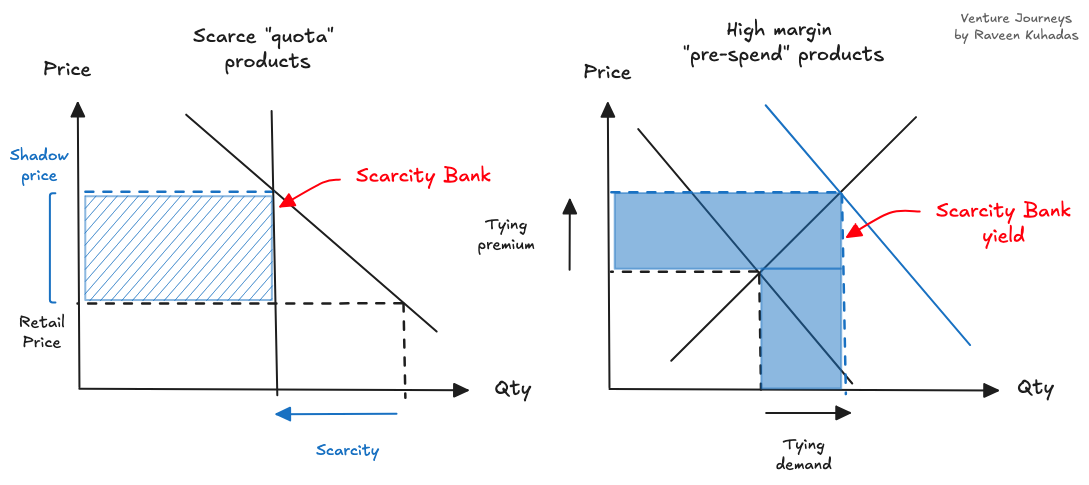
While an elegant model, traditional financial metrics (margins, inventory turnover, etc.) cannot tell investors when the Scarcity Bank is being unsustainably drawn down. Because flagship quota bags are in short supply, a company can keep selling through its inventory at full price right up until the bank is exhausted—at which point the brand damage takes years to repair. This is why investors need external indicators to track the health of the Scarcity Bank, especially as technology magnifies the impact of economic cycles.
The Health of the Scarcity Bank - The Risk of Economic Booms
There have been well-known cyclical market challenges recently, such as higher interest rates and a slowdown in luxury spending in China. For luxury companies like Hermès, the Scarcity Bank should act as an “elasticity shield” that protects the company’s store sales and retail pricing power against the vagaries of market cycles.
A healthy Scarcity Bank provides more value to customers than what it costs them to unlock it. That is, the secondary market resale premium on a quota product must exceed the accumulated net cost of the pre-spend products required to get access to one. During a downturn, the Scarcity Bank absorbs the macro shock. The resale premium takes a hit and the flagship leather bag waitlist shortens. However, as long as supply is kept scarce and the resale premium still exceeds the net cost of the pre-spend, customers will stay in the waitlist queue, leaving the company’s leather sales untouched.
Paradoxically, it is during economic booms that companies need to be wary of long-term damage to the Scarcity Bank. During these times, a speculative class of customers appears. These customers care nothing for the brand heritage or craftsmanship of the Birkin. Instead, they are motivated by the ballooning resale profit they can realise and spend aggressively on pre-spend products. Their aggressive spending squeezes out genuine brand enthusiasts or at least increases their cost to acquire a Birkin or Kelly bag.
We can see this pattern during the boom-time pre-spend surge in Hermès’ segment results. Between 2017 and 2020, Hermès’ non-leather divisions (“Other products” in the chart below) and its flagship Leather Goods & Saddlery division grew in line with each other at a 1.0x ratio. However, non-leather revenue grew significantly ahead of leather from 2021. It peaked at 1.4x leather revenue in 2023 (€7,880m vs. €5,547m) before starting to cool to 1.3x in 2025 as the speculative boom unwound.
Chart 3: Hermès’ Non-leather revenue (“Other products”) has pulled ahead of Leather & Saddlery since 2021 and peaked in 2023
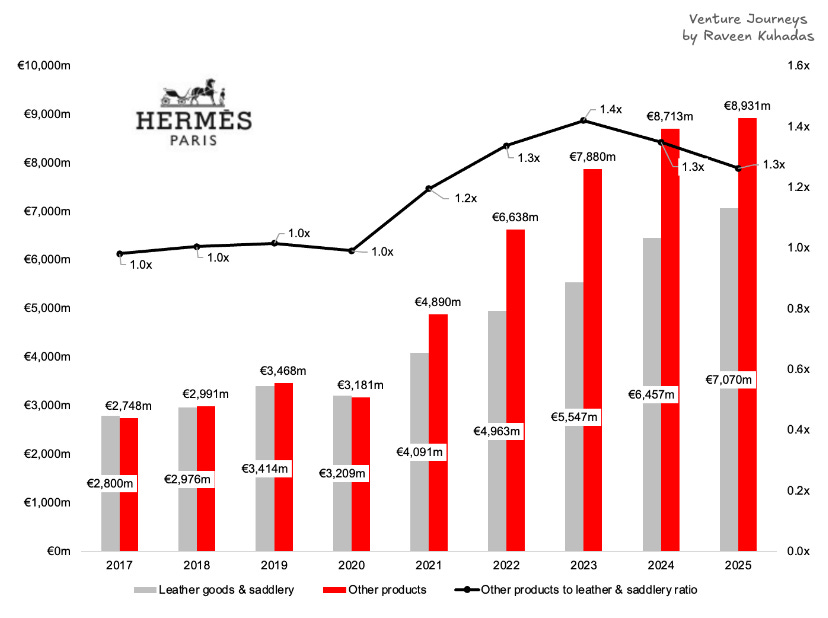
Source: Hermès company documents, Venture Journeys
What Technology Changed
The problem for Hermès is that speculative buyers are not users of the product. They need to consider financing costs and are always looking for the next deal. As such, they don’t hold onto their bag purchases. They value liquidity, the ability to sell their purchases quickly rather than holding out for a higher price.
And luxury retail technology platforms like The RealReal and Rebag are their ideal partners. These platforms earn a commission on every sale. The more transactions they can facilitate, the better.
“On the seller side, we’ve built a model that eliminates friction from the process of selling. The $200 billion of supply that I mentioned earlier, we see that as trapped in people’s closets, and The RealReal is effectively unlocking that supply, bringing it onto our platform from where it sells very quickly. 50% of what we launch is gone in 30 days in terms of sell-through rate.” Ajay Gopal, CFO of The RealReal, 38th Annual Roth Conference, March 2026
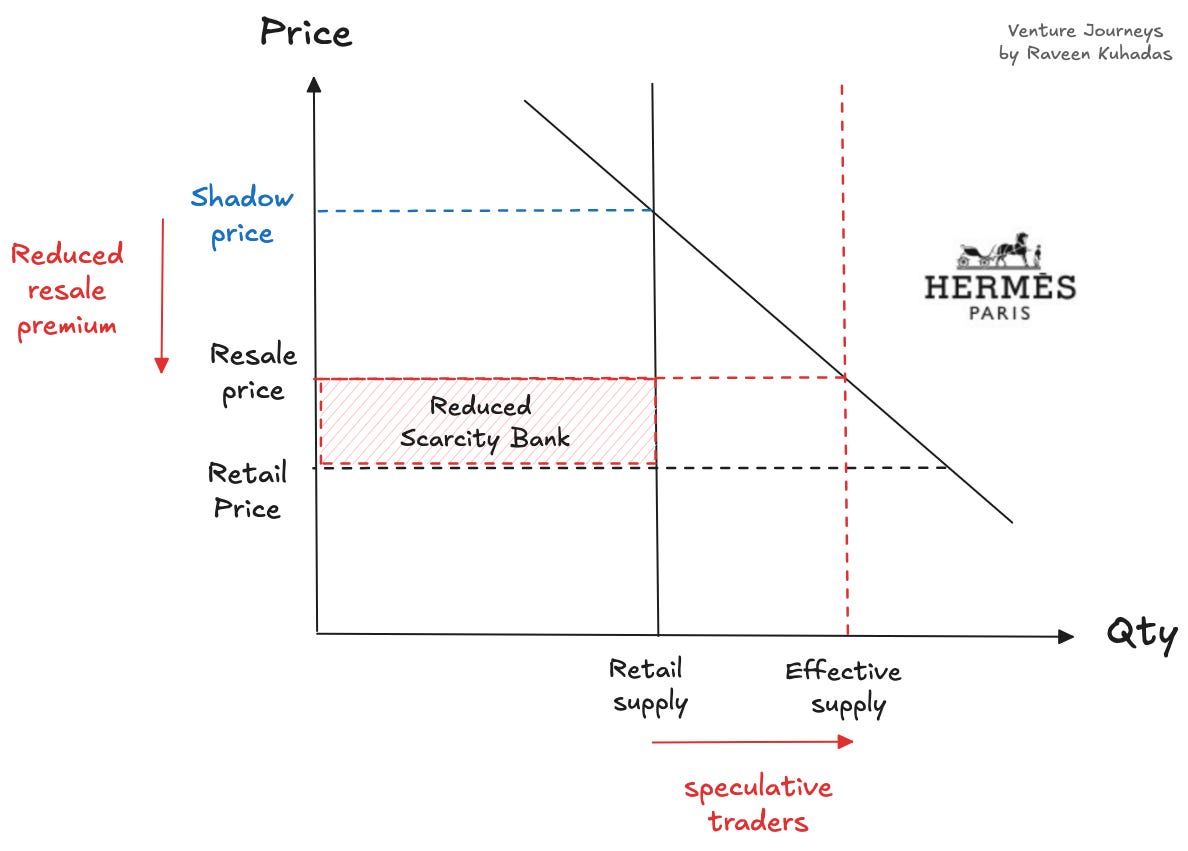
Gopal’s comments highlight the issue. The RealReal’s platform is about unlocking supply that is “trapped in people’s closets” – giving speculative resellers an engine for selling it quickly. This increases the “effective supply” of scarce leather bags on the open market, being Hermès’ retail production plus second-hand bags for sale. As shown in the chart below, this extra secondary supply pushes down the resale price and shrinks the Scarcity Bank available to Hermès on its own retail sales.
Chart 4: Increased effective supply reduces the Scarcity Bank available to the company
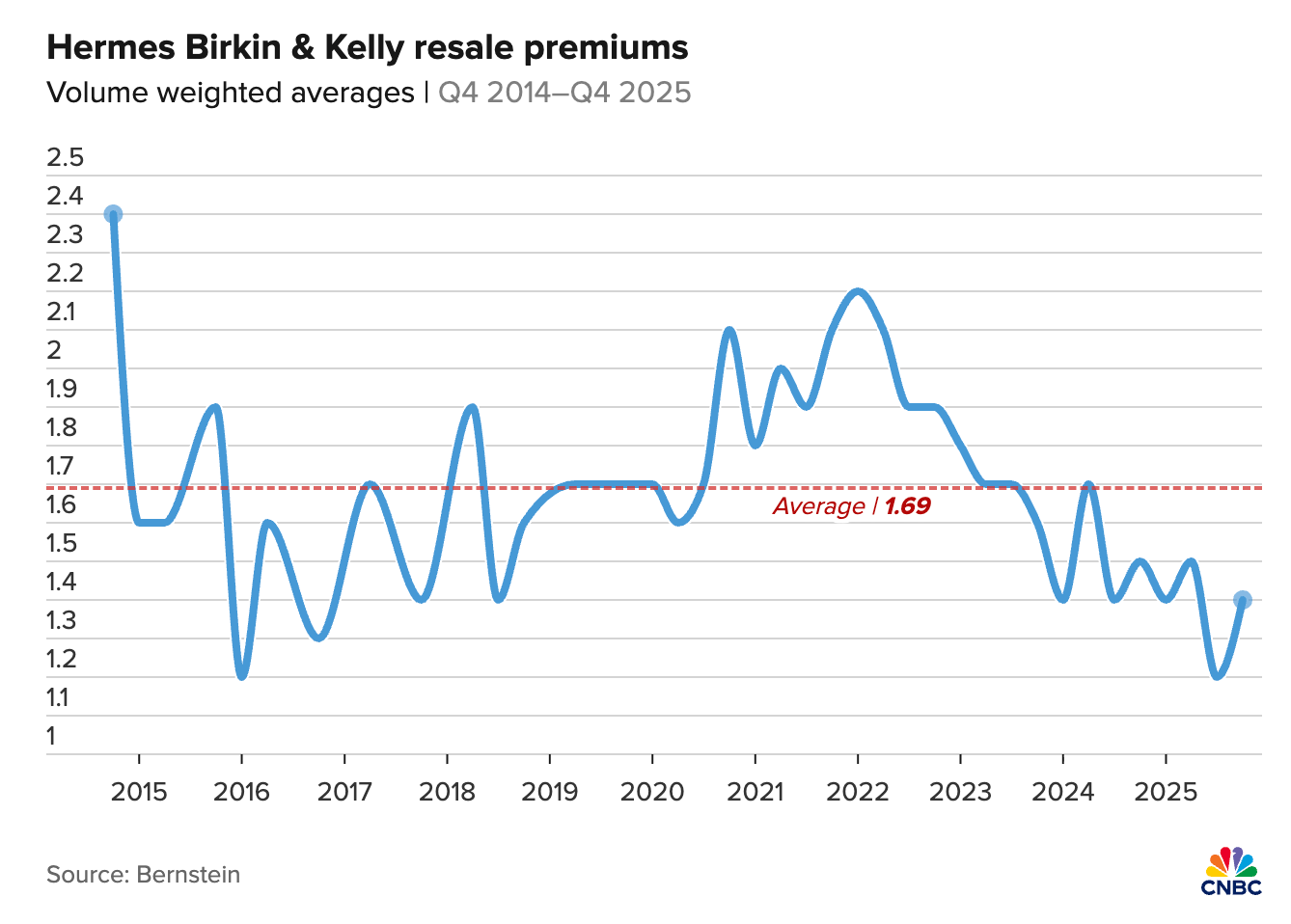
Investors have been paying attention, with equity research firms such as Bernstein tracking resale premiums of flagship Birkin and Kelly bags as shown in the chart below. You can see the impact of the speculative boom from 2021 to 2022, with the cooling thereafter. The average premium peaked at 2.2x retail in early 2022 and ended 2025 at 1.3x. The non-leather ratio in Chart 3 followed about a year later, peaking in 2023. With the Bernstein analyst recently revising his outlook and acknowledging that Hermès may not be entirely shielded from a consumer slowdown, it is increasingly clear that the company must address the impact of speculative sellers.
Chart 5: Bernstein estimates of Hermès’ resale premiums show declines from their 2022 peak
Restoring the Scarcity Bank - Controlling the resale market
“The negative side, and I must say this in the field of speculation, sometimes we have false customers who come to our stores to buy them, to resell them, and they prevent us from serving our real customers, and that is a real cause for concern for us…So I’m not at all happy to see this development of new bags that are sold in second-hand market… I’m not happy and it doesn’t make me feel in a good mood.” Axel Dumas, Hermès International Executive Chairman, 2Q25 earnings conference call
It’s clear that Dumas isn’t happy, but his comments only partially describe the true danger to Hermès. When speculative buyers offer their newly allocated bags onto second-hand markets, it not only squeezes out genuine Hermès customers, but also reduces the crucial perception of scarcity.
How scarce can a bag be if customers can buy a good-as-new Birkin bag instantly, rather than going through a long Hermès waitlist? Should the resale price fall towards the retail price (or the resale premium fall below the cost of pre-spend), these bags will lose their elasticity shield. Hermès’ pricing power and demand would be exposed to volatile market cycles, resulting in permanent damage to the brand.
Hermès doesn’t set resale prices, as they are the result of decisions of thousands of buyers and sellers. But it can influence them, as Rolex has shown.
In 2022, Rolex faced its own post-COVID secondary market glut. Faced with declining resale prices, Rolex needed a way to intervene in the second-hand market to restore its Scarcity Bank. So Rolex launched its Certified Pre-Owned program (CPO program), where its authorised retail partners would buy back second-hand watches. Rolex would certify them and issue a warranty. Retail partners would then sell the certified used watches.
There are three key aspects of this strategy:
Create a price premium: Manufacturer certification differentiated watches sold by Rolex’s authorised retailers from those sold by independent resellers, introducing a 20-30% price premium.
Profitable buybacks: This premium made buying back second-hand watches profitable for retail partners.
Mandated holding period: Rolex only certifies watches that are at least 3 years old (more recently reduced to 2 years). This disincentivised resellers from selling “near-new” models, reducing the effective supply of the closest substitutes for Rolex’s retail sales of new watches.
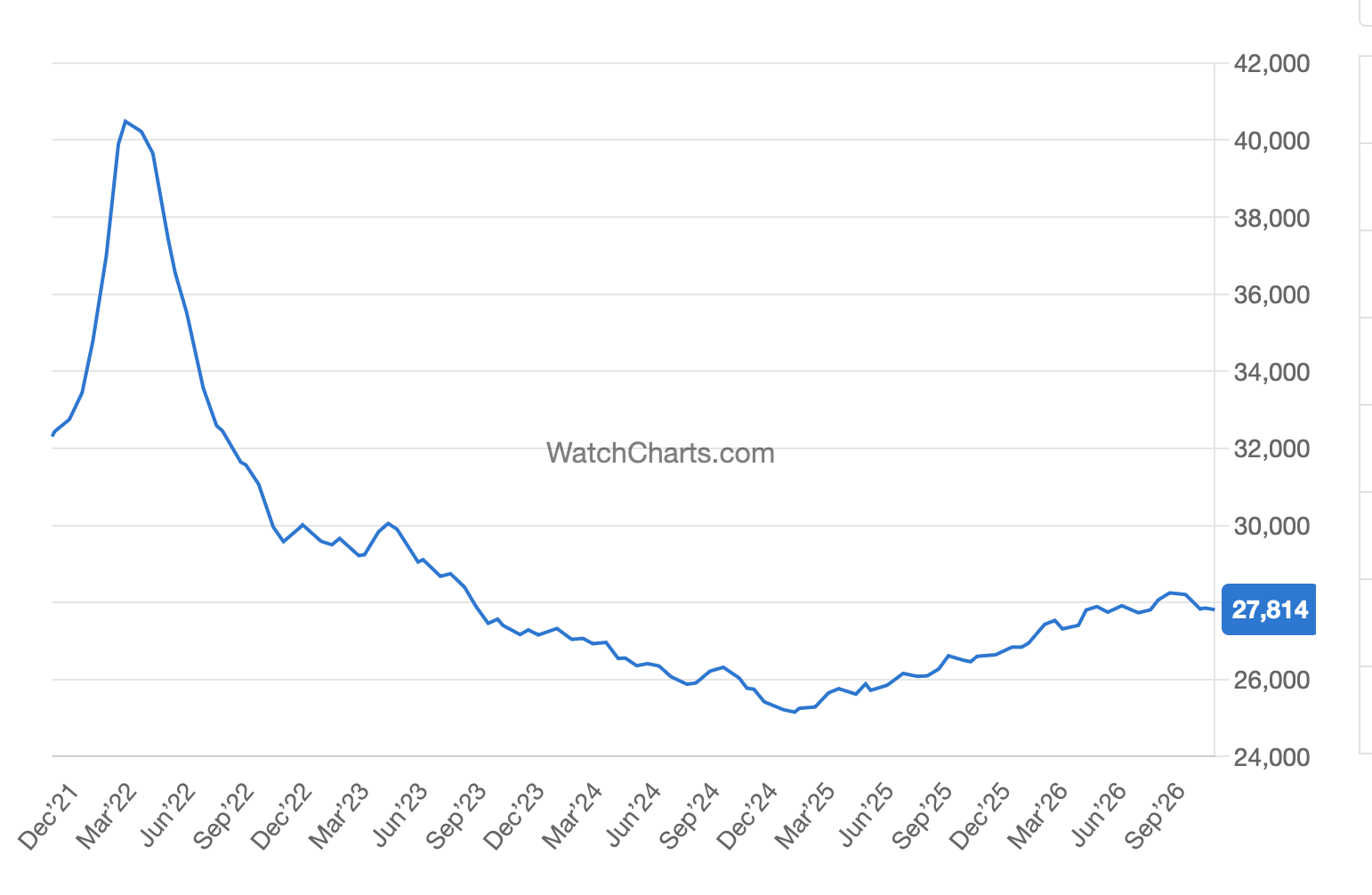
The program has grown quickly. EveryWatch estimated Rolex’s CPO program sales doubled to $385mn in the first half of 2026, and exceeded sales of unworn Rolex watches on the grey market ($334.5mn, declining 25%). That fall in unworn sales is the clearest sign the holding period is working. The program is still small, at about 9% of the $4.29bn of Rolex watches sold second-hand in the first half of 2026. According to WatchCharts.com’s secondary market index of Rolex’s top 30 models, resale prices have begun to recover from March 2025.
Chart 6: Rolex secondary market prices (US$) have recovered since March 2025 alongside the growth of its Certified Pre-Owned program
Source: WatchCharts.com
Hermès has no comparable program. Rumours point to initiatives in its retail stores, including greater centralisation of Birkin or Kelly leather bag allocations and longer wait times. While this may balance future supply, it does not reduce the current speculative glut pressuring resale prices. Even with recent stabilisation, Saclab estimates that the average Birkin and Kelly resale prices on its platform in the first half of 2026 remain 11% lower than 2023.
Hermès’ hesitation to directly buy back its classic quota bags is understandable. There is less scope for warranties and certifications to differentiate leather bags compared to complex Rolex watches. Unlike Rolex when it started its CPO program, Hermès owns its retail stores. It would therefore trigger a significant investment phase, given the working capital Hermès would spend to repurchase the bags. Most significantly, there is the potential to disrupt its lucrative pre-spend model, even if that opaque waitlist is increasingly frustrating genuine customers (some of whom previously launched a lawsuit). A certified pre-owned bag sold in a boutique puts an official price on skipping the quota waitlist, reducing the incentive to purchase pre-spend products.
Conclusion
For any luxury franchise, scarcity is a finite capital account: management must draw enough yield from it to drive growth, without eroding the principal that sustains the brand’s pricing power.
The fall in secondary bag premiums since 2022, followed by the rollover in Hermès’ non-leather revenue ratio from 2023, suggests the company overdrew from its Scarcity Bank during the COVID-era boom. If secondary market demand remains muted, tightening store waitlists alone may not be enough to clear the supply overhang.
Like Rolex, Hermès may eventually be compelled to step directly into the resale market, buying back eligible second-hand stock and reselling Hermès-endorsed bags at a premium. Such a pivot would create an uncomfortably volatile period for investors, most notably because it could disrupt Hermès’ pre-spend waitlist model which has grown materially since COVID.
On a potential positive note, taking control of the secondary channel would improve Hermès’ competitive moat over the long term. The resale spread currently pocketed by speculative “false customers” could fund overdue, customer-friendly reforms to an opaque and annoying waitlist model. This would improve Hermès’ ability to defend its Scarcity Bank for the next generation of collectors.
Venture Journeys articles are provided for informational purposes only and should not be construed as investment, business, legal or tax advice. Please do your own research or consult advisors on these subjects.