
The risk to SaaS companies isn’t that the AI-model companies will replace them — it’s that they will reprice them. Platform economics run on usage, and platforms grow usage by driving down the price of everything around them. Usage-based pricing is the instrument, it unbundles the software subscription just as iTunes unbundled the album. When these forces hit the record industry, profits took sixteen years to recover.
To avoid the painful experience of the music industry, SaaS companies must do what platforms structurally cannot: sell accountable customer outcomes rather than workflow tools — and price the outcome, not the token.
Defining the “Usage-based Tax”
I love listening to Tracy Chapman’s Fast Car. Over the gentle strumming of the guitar and with a voice packed with emotion, Tracy sang about leaving her current circumstances behind and driving to a hopeful new destination. This is a theme that any aspiring writer (and increasingly battered SaaS investor!) can relate to. Fast Car was by far the most popular song from her debut 1988 album – and neatly illustrates the disruption faced by the music industry in the early 2000s.
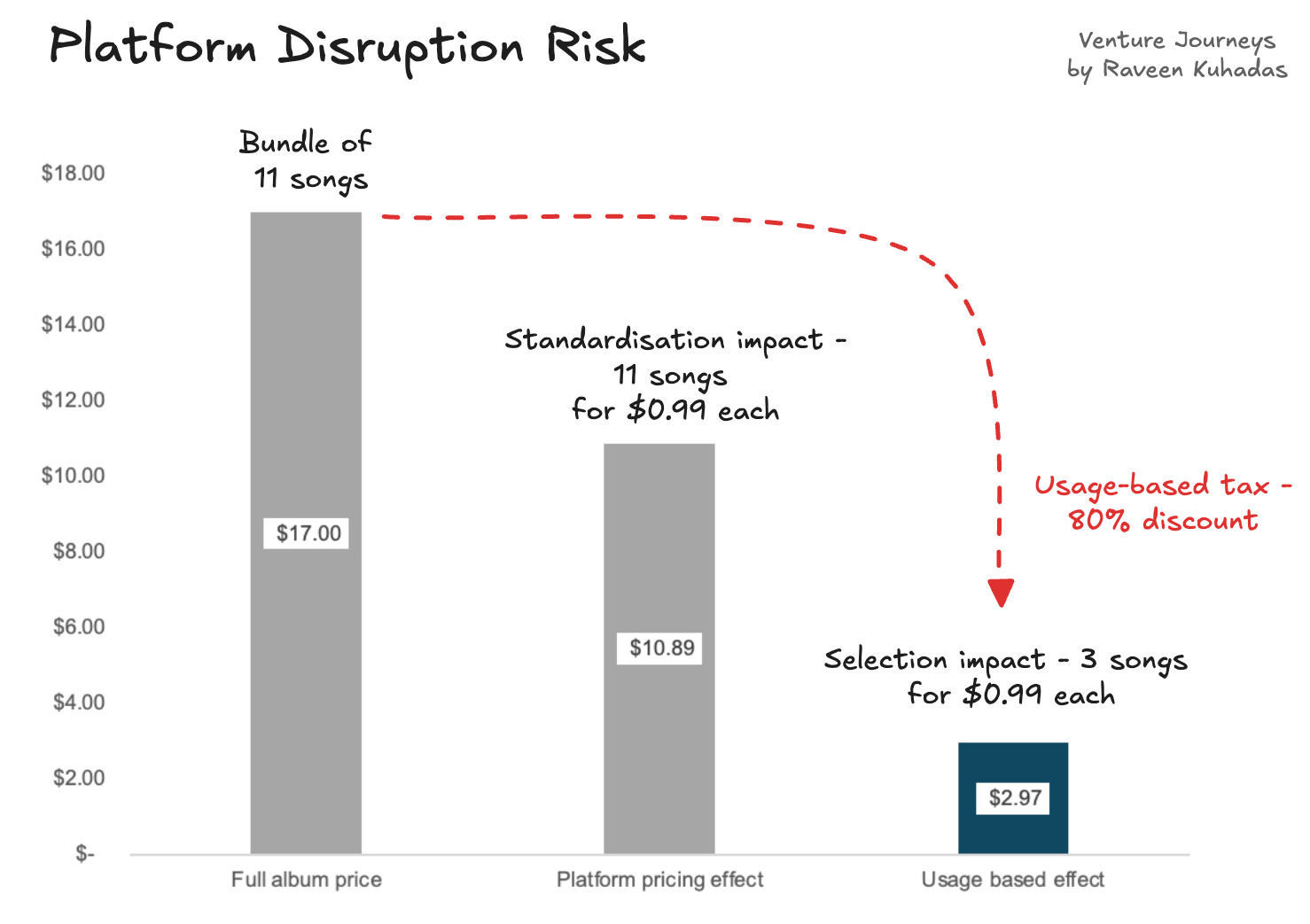
Back then, music was sold in albums which packaged a collection of songs. Tracy’s album had 11 songs and an album might have sold for $17 in the 1990s or early 2000s. So a consumer was paying circa $1.55 per song. The advent of Apple’s iTunes Store allowed consumers to pay $0.99 per song. In isolation, this standardisation impact of the fixed pricing imposed by Apple’s platform would have reduced the record company’s price by ~36% to $10.89 for 11 songs.
As bad as it sounds, this wasn’t the record company’s only issue. Turns out the other songs in Tracy’s album were not nearly as popular as Fast Car.
Selection impact - Only 3 songs make up over 80% of the views on Youtube*
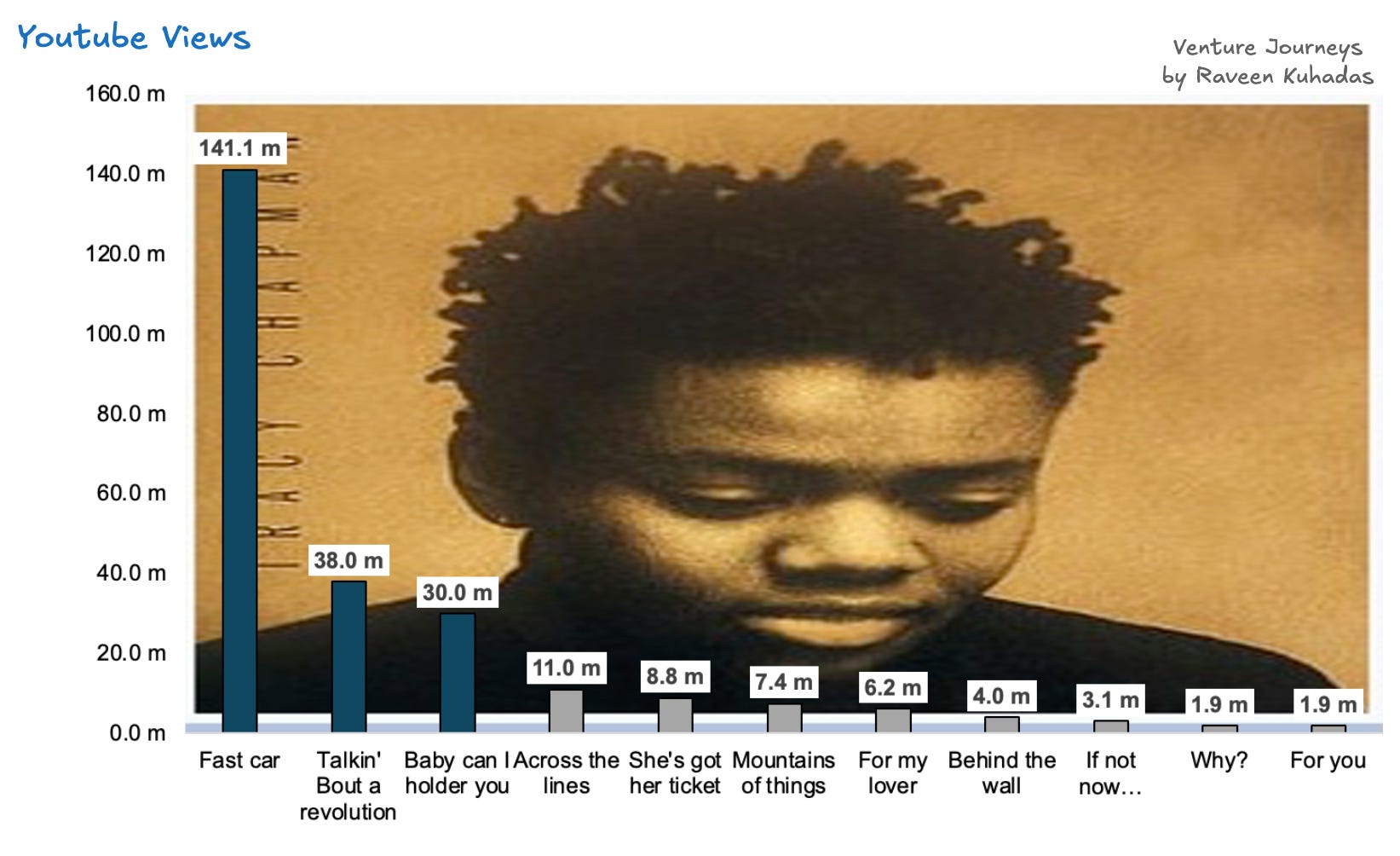
As seen above, 3 songs made up the vast majority of usage. Under Apple’s pricing model, this selection impact meant the record company would only receive $2.97 for the album. That’s a drop of over 80%!
I call this the “Usage-based Tax” – a one-two punch of a standardisation and selection based impacts imposed by platforms on their suppliers. The eccentric personalities and talents of artists and their storied albums were standardised into $0.99 songs, which consumers could easily compare and select for their individual playlists. It was great for the consumer, but incredibly deflationary for the record companies.
The Usage-based Tax - an illustrative example showing the dual impacts of standardisation and selection
In an interview with HBS Working Knowledge, Anita Elberse effectively summed up the plight of the record label companies.
“Sure, you could still purchase an entire album. But consumers found more value in cherry-picking favourite tunes for much less money…So despite selling record numbers of individual songs on online services such as Apple’s iTunes, the labels are in an era of declining revenues and consolidation.” Anita Elberse, Harvard Business School Professor, HBS Working Knowledge, November 2009
The disruption faced by the record label companies is highly analogous to the risk facing SaaS companies from the usage-based dynamics being pushed by AI model companies. Like the old music albums, software companies bundle multiple features within one subscription (a dynamic I explored in my previous article on Microsoft). If you are a SaaS company, it’s not about selling less of your software – it’s about selling it for a lot less.
The Platform Playbook: Unbundling via Usage-based Pricing
To understand where SaaS pricing is heading, we have to look at the nature of platforms. Dominant platforms historically form during periods of technological disruption. The reason – it’s their chance to build the expensive, foundational infrastructure that the rest of the industry will eventually rely on. We saw this with Amazon building the logistics network for online retail. Today, we are seeing it repeat with capital-hungry AI model companies.
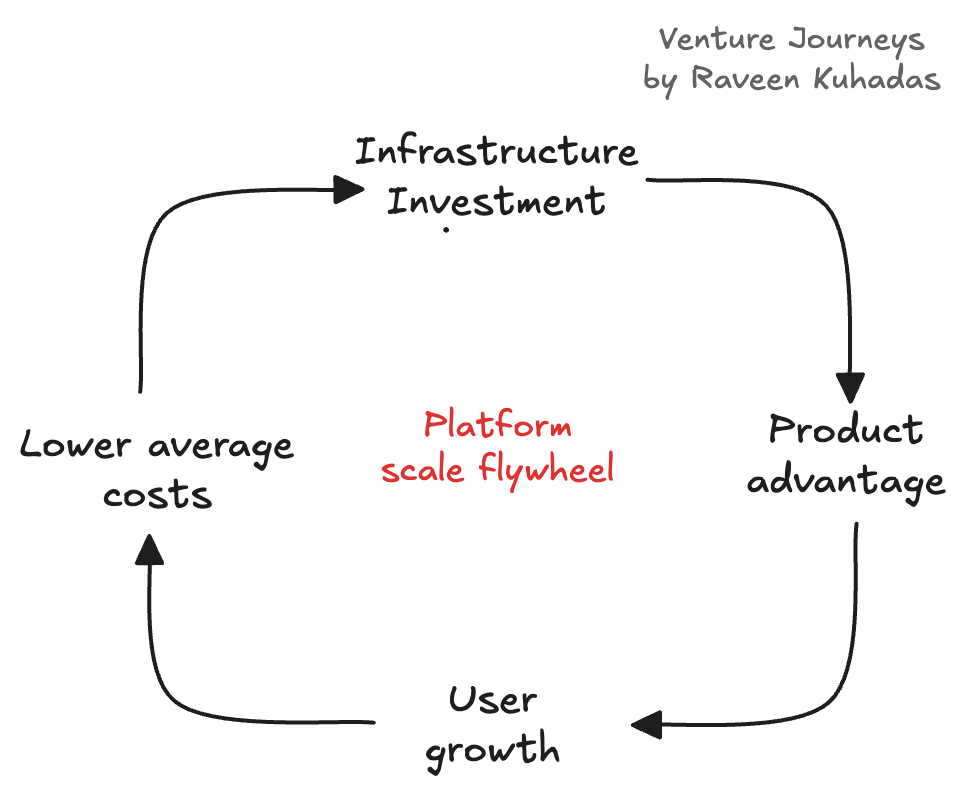
The defining characteristic of these platform builders is their extreme capital intensity. High fixed costs incentivise platforms to spread them across as many users as possible. This creates an important first-mover advantage: the upfront investment allows them to capture early users, which reduces their average cost per user, enabling them to lower prices, which in turn captures even more users in a classic scale flywheel.
The platform scale flywheel drives a first-mover advantage
To drive this flywheel, platforms typically employ a ruthless strategy called “Commoditising your complements”, coined by Joel Spolsky in his classic 2002 essay. The economic principle is simple: make the products around your platform cheaper and more abundant so demand for your own platform rises. For the AI model companies, SaaS applications are the complements that make their AI applications, like ChatGPT and Claude, more useful.
To drive down pricing, platforms will attempt to standardise their suppliers — mandating common attributes that make them more comparable. This is the standardisation impact from the iTunes example — and Booking.com ran the same play, reducing those quaint European hotels to a star rating and a price.
This process exposes the undifferentiated parts of products to risk – it’s a lot easier for new competitors to build for individual features rather than an entire software bundle. Users select for the most cost effective option, driving them away from the overpriced features.
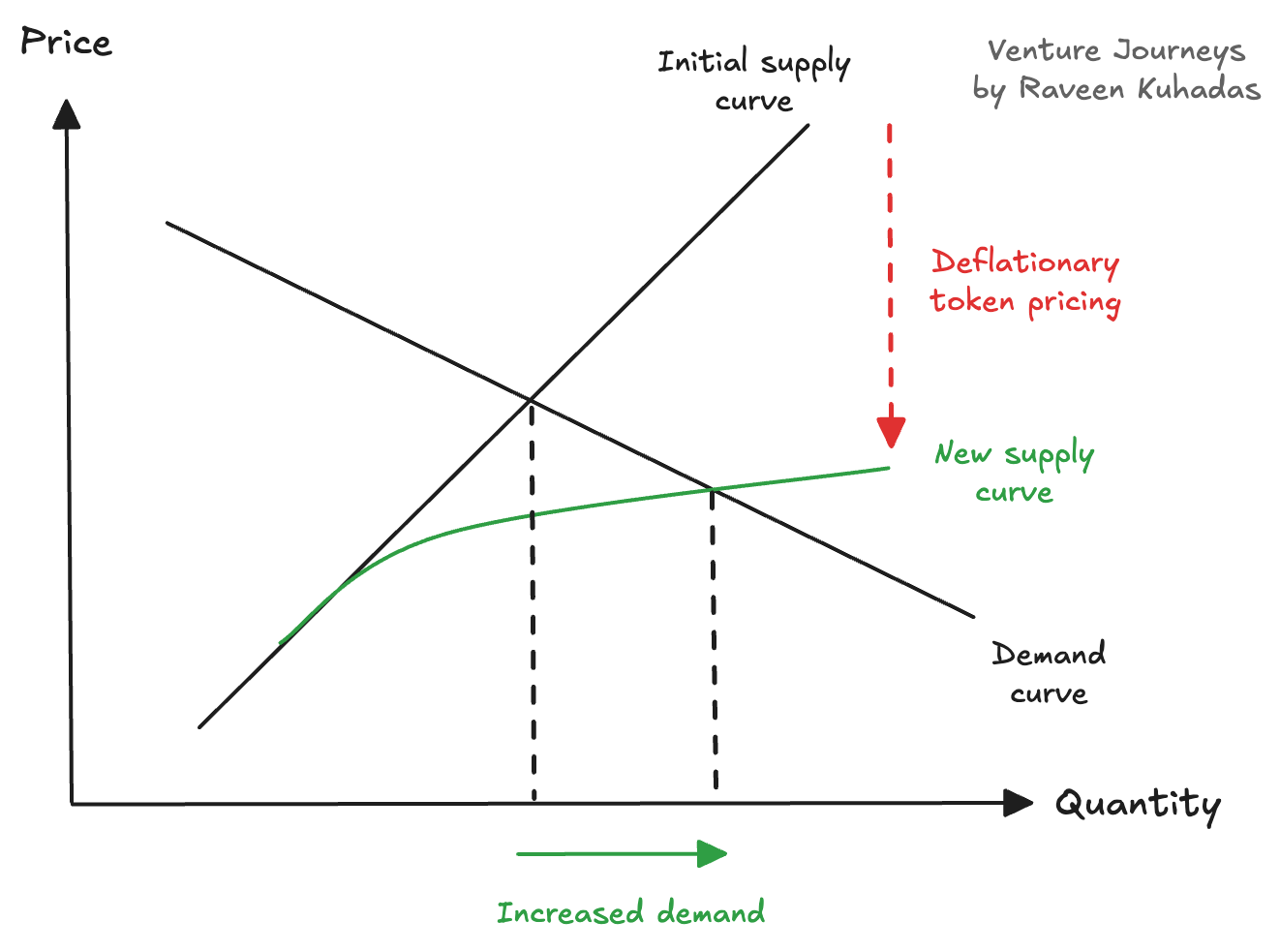
Pricing is the mechanism that turns strategy into market impact. AI model companies want AI-related features metered by usage, with the token as the standard unit. That makes AI inference look like a cheap, deflating commodity and encourages everything above it — such as SaaS features — to be judged as a markup on that cost.
Token denominated usage-based pricing is designed to drive price reductions from suppliers
The usage-based platform threat is especially acute for the economics and enviable gross margins of SaaS companies.
Structural Vulnerability: Unravelling the SaaS Cross-Subsidy
SaaS companies enjoyed a defining economic feature – near “zero” marginal costs. Once the software was built, additional customers and heavier usage added little incremental cost. Revenue could scale faster than cost, gross margins stayed high, and investors rewarded the model accordingly.
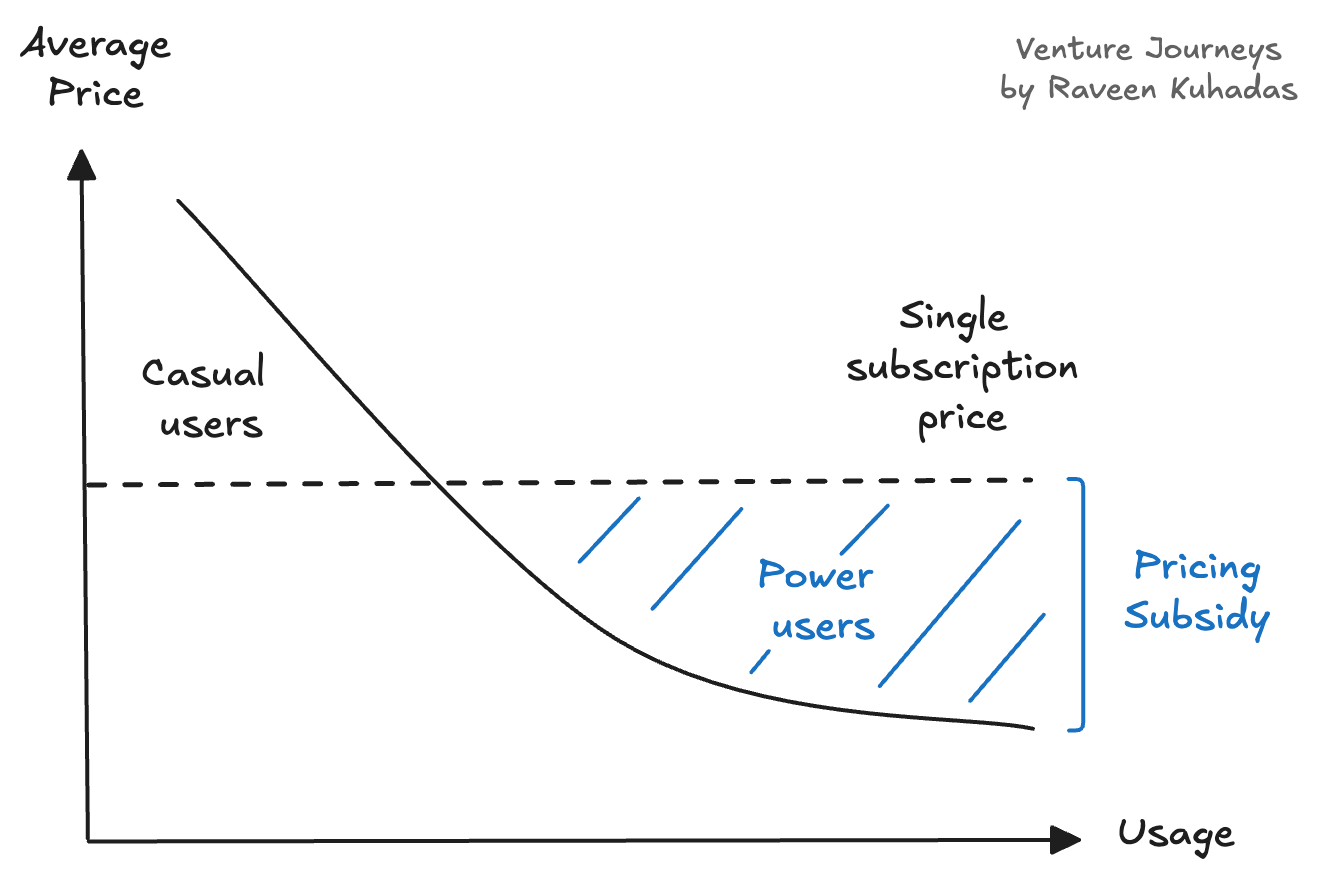
This super-charged the SaaS bundle. Bundling is a pricing strategy that allows a cross-subsidisation of growth. It lets a company charge a single price across users with different usage levels and willingness to pay. “Power users” drive demand because they value a small set of expensive, advanced features that make the bundle feel indispensable, while “casual users” supply the margin — paying full price for access but consuming little. Cable television is the other classic case: costly sports rights retained a passionate minority, yet their cost was spread across the entire subscriber base, including the many who watched little or no sport.
But unlike cable companies, whose content costs often rose with subscriber growth, SaaS companies faced little incremental cost from additional subscribers, including those demanding expensive features and heavier usage.
However, bundles need to be enforced to be effective. If offered a choice, the casual user would opt out of the expensive power features. Control of the customer relationship is therefore the key to maintaining a bundle. The cable companies famously lost that control to internet-age companies like Netflix.
In my previous article on SaaS disruption, I argued that AI model companies like OpenAI and Anthropic (and potentially Microsoft) are in a prime position to control customer access due to their rapidly growing subscriber bases and access to immense funding. This attacks the SaaS bundle in two ways.
First, the variable inference costs charged by the AI model companies mean marginal cost is no longer zero. The power users who once drove growth and retention are now the most expensive to serve. The single bundle price that once made every subscriber profitable now guarantees some are not.
The end of “zero” marginal costs: Power users of AI features cost more to serve
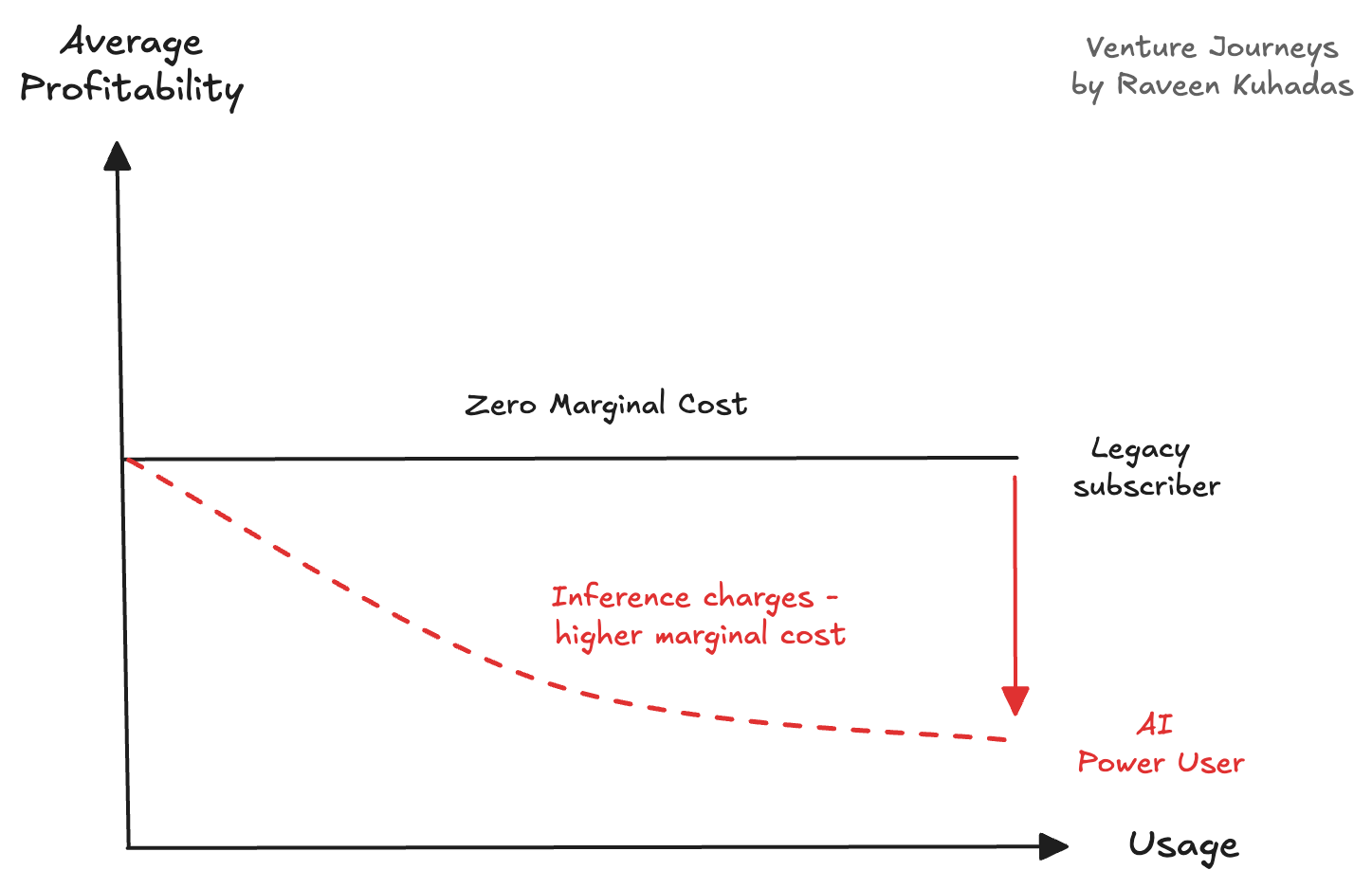
With their core economic feature undermined, SaaS companies are now open to the Usage-based Tax. The usage-based pricing dynamic that AI model companies introduce allows customers to isolate the specific features they actually want to use – the selection impact. This means casual users will only pay for what they use—and will no longer have to subsidise the power users. Casual users will also become far more price sensitive, as token denominated pricing reduces features to directly comparable units — the standardisation impact.
But wait! SaaS company investor calls are awash with CEOs expecting the innovations that AI will unlock to grow their total addressable markets! That may be true. After all, the record companies seem to be back on their feet. Let’s see how long it took them by observing the financial performance of Universal Music, one of the leading record companies.
Lengthy recovery - It took 16yrs for Universal Music to recover its profitability to 2001 levels
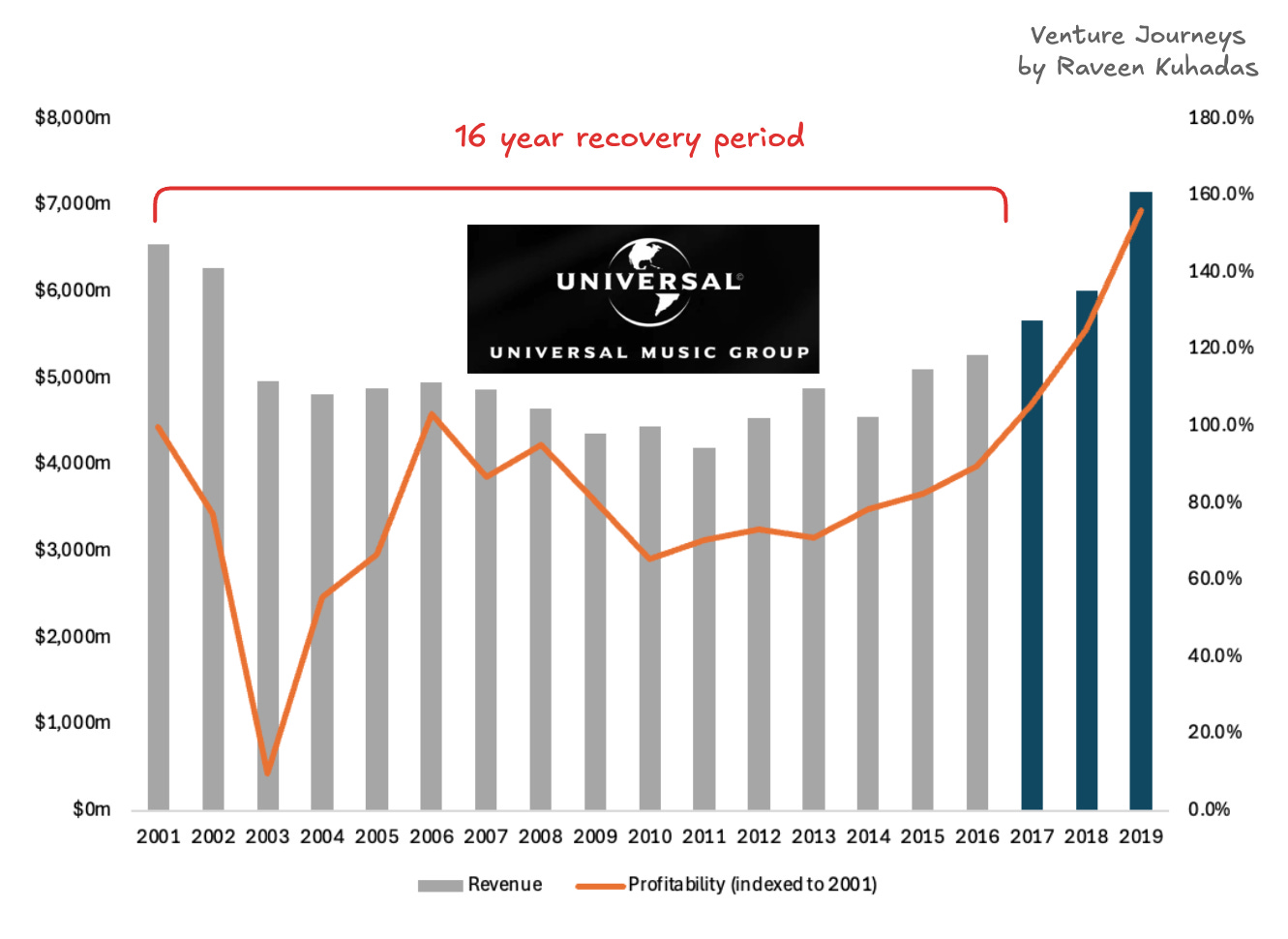
Universal Music Group financials sourced from Vivendi financial accounts. Profitability represented by EBITA referenced to 2001
Yikes! It took Universal Music Group 16 years for profits to recover to levels seen in 2001. I’m a long-term Salesforce shareholder, but I may need to wait for retirement before I get my money back!
Thankfully, the leadership teams of some SaaS companies appear to be far more aware of the risks than the record label executives from the early 2000s. The solution lies in providing what platforms structurally cannot.
The SaaS Defence: What Platforms Structurally Cannot Do
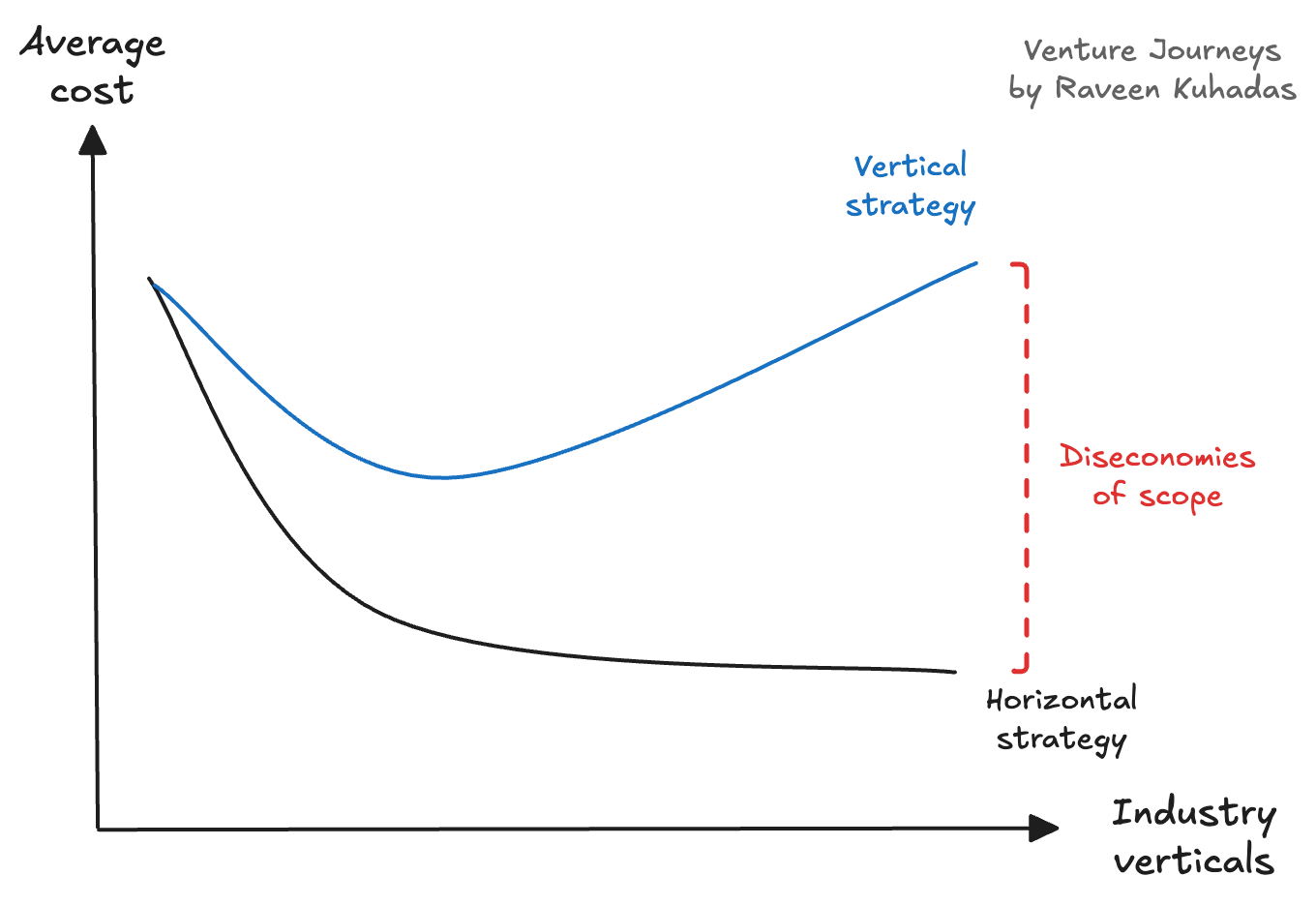
Capital intensive platforms tend to pursue a horizontal strategy as the aggregation of customers across several industry verticals allows them to spread the enormous infrastructure costs. They therefore prefer generalised capabilities that can be reused across many verticals. But high-stakes software is not just about capability; it is about accountability and ultimately, producing business outcomes. As I described in my previous article on SaaS disruption, this requires integration with specific company data and context that varies significantly across industries.
This is anathema to platforms, not least because it will require investments that could only ever be used by customers in a particular industry vertical. This strategy triggers diseconomies of scope—the more verticals the platform expands into, the higher the average cost of its solution.
Platforms avoid vertical strategies where specialised investments lead to diseconomies of scope and higher average costs
Such a strategic gap creates an opportunity for SaaS companies. Let the AI models and their generalised platforms such as Claude provide the capability. The strategy for SaaS companies is to harness the AI models to generate business outcomes on which they can build profitable usage-based pricing models – untethered from the deflationary chains of token-based pricing.
Understanding the software bundle reveals the opportunity. In a traditional subscription bundle, the heavily subsidised power users have been underpriced. Incorporating AI-powered features allows SaaS products to create exponentially more value for these heavy users—value they should be willing to pay for.
The usage-based opportunity - Power users are currently underpriced
To compensate for the loss of casual users, it is imperative that SaaS companies develop effective usage-based pricing models based on customer outcomes, not token cost. Companies such as Salesforce are building for exactly that.
Salesforce’s Strategy: Reclaiming the Pricing Unit
At a recent investor conference, Salesforce executive vice president Bill Patterson spoke to Salesforce’s pricing strategy:
“Today, most of the world is infatuated with the token… One of the things that we’re starting to do some more experimentation on is more value-based and outcome-based pricing of these consumption offerings, because, again, where we want to be is the company that doesn’t just sort of monetize compute and storage, like a hyperscaler does, we want to monetize the outcome that comes off of the software” Bill Patterson, Salesforce EVP of Corporate Strategy at the Jefferies Software, Internet & AI Conference, May 2026
Bill’s message was clear – valuing Salesforce’s software with tokens is akin to judging the quality of a Michelin-starred dish by its calories. C’est non!
Customers do not care how many tokens Salesforce consumes. They care about what its software accomplishes: increasing revenue, lowering costs or improving customer service.
The challenge is accountability. As I described in my initial disruption article nearly two years ago, SaaS applications have traditionally helped people perform workflows while leaving them responsible for the final result. To charge for outcomes, Salesforce must control enough of the workflow to deliver, verify and stand behind them. This helps explain Salesforce’s $15bn acquisition push since late 2024.
Salesforce has announced ~$15bn on AI-related acquisitions in the last 18-20 months
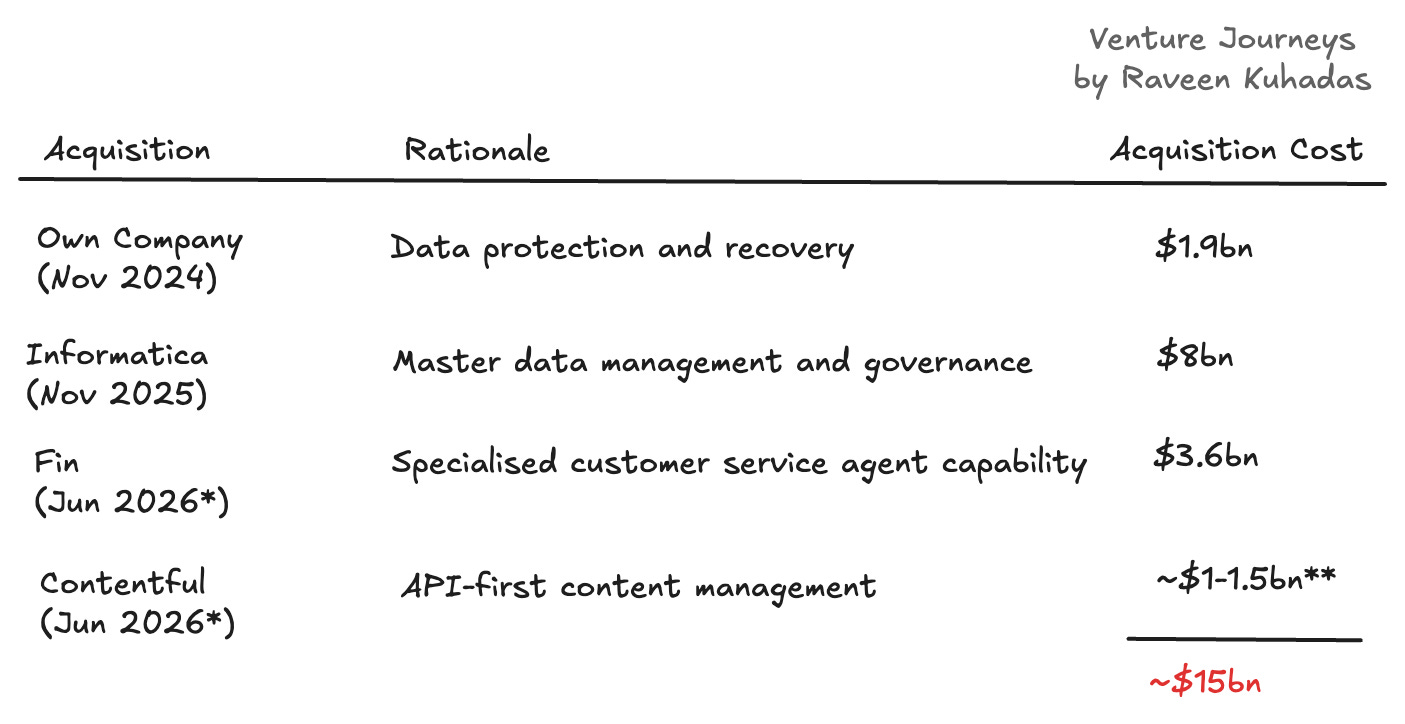
*Fin and Contentful acquisitions announced in June 2026 and expected to complete in FY27. **Estimated Contentful acquisition cost sourced from The Information.
Together, these acquisitions suggest Salesforce is trying to move from being primarily a system of record towards becoming a system of action. The more work it can complete and verify inside its platform, the stronger its claim to price the work performed rather than the tokens consumed.
The Agentic Work Unit, or AWU, is an early attempt to measure that shift. Salesforce defines an AWU as a discrete task executed by an AI agent.
Salesforce now reports platform usage in Agentic Work Units (AWUs).
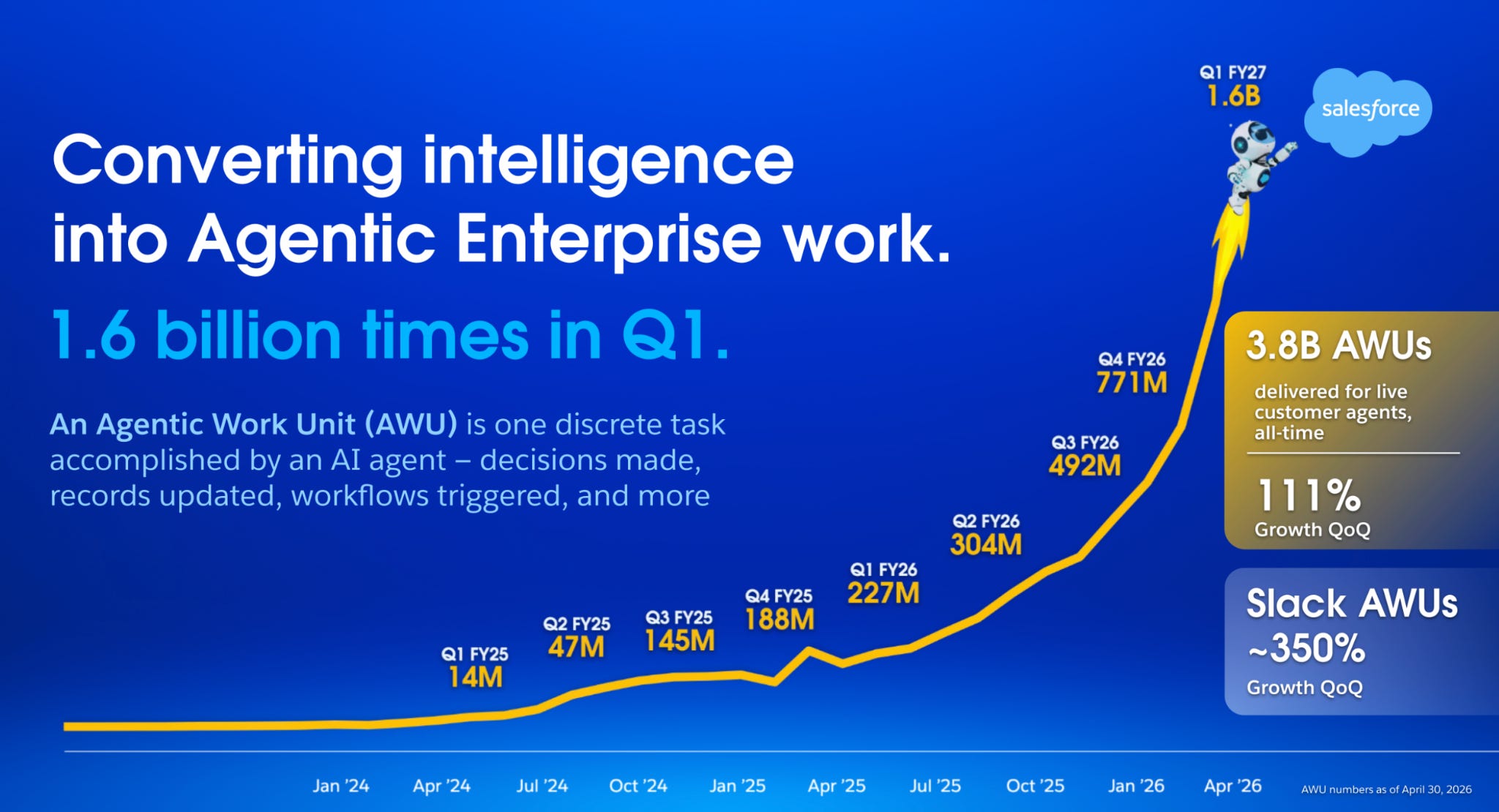
The early usage figures are encouraging. The company’s chart shows AWU consumption increased by around 7x over 12 months (1.6bn in Q1 FY27 compared to 227mn in Q1 FY26).
However, tasks completed are more akin to activity rather than business outcomes – and for investors, activity is not the same as monetisation. Over the same period, AI related Agentforce and Data 360 annual recurring revenue increased circa 200% (~100% excluding the newly acquired Informatica). Current remaining performance obligations (cRPO)—the critical leading indicator for committed client spend—increased by only 14%.
For AWUs to transition from a measurement metric into a pricing unit, Salesforce must prove that AWU growth translates into dollars. Demonstrating a closer relationship between AWU and revenue will be key for investor confidence over the coming quarters.
The Investor Test: Adoption Is Not Pricing Power
The threat from the AI-model platforms is misunderstood. They are not trying to replace their SaaS partners; they want to drastically reprice them through the Usage-based Tax. The one-two punch of standardisation and selection strikes at the heart of SaaS economics — and it took the record labels sixteen years to recover from the same blow. That is what’s at stake for SaaS companies that succumb to token-based pricing.
Success requires more than a press release. On their own, announcements of MCP servers and deals with OpenAI and Anthropic are increasingly a red flag — they make a company’s features easier for agents to access, and therefore easier to compare and commoditise.
To protect their profitability, SaaS companies must do what platforms structurally cannot: deliver accountable customer outcomes — and price the outcome, not the token. Achieving this is not straightforward, and requires significant investment. Salesforce has recently invested billions building out its agentic capabilities, and its Agentic Work Unit moves measurement closer to work performed than tokens consumed — but it still measures activity rather than customer value.
That gap defines the underwriting test for the coming quarters: does AWU growth translate into revenue growth, retention and sustainable gross margins? For SaaS at large, the bar is the same. Adoption is not pricing power unless usage converts into outcomes customers pay for.
Venture Journeys articles are provided for informational purposes only and should not be construed as investment, business, legal or tax advice. Please do your own research or consult advisors on these subjects.